Slayers of Moloch: Building Agentic Systems at Devconnect
This November in Boulder, Colorado — I had the opportunity to work with Gitcoin and Lucian Hymer, a full-stack blockchain engineer, on a project that quietly reshaped how I think about the future of meta-currency in today's New Active Economies.
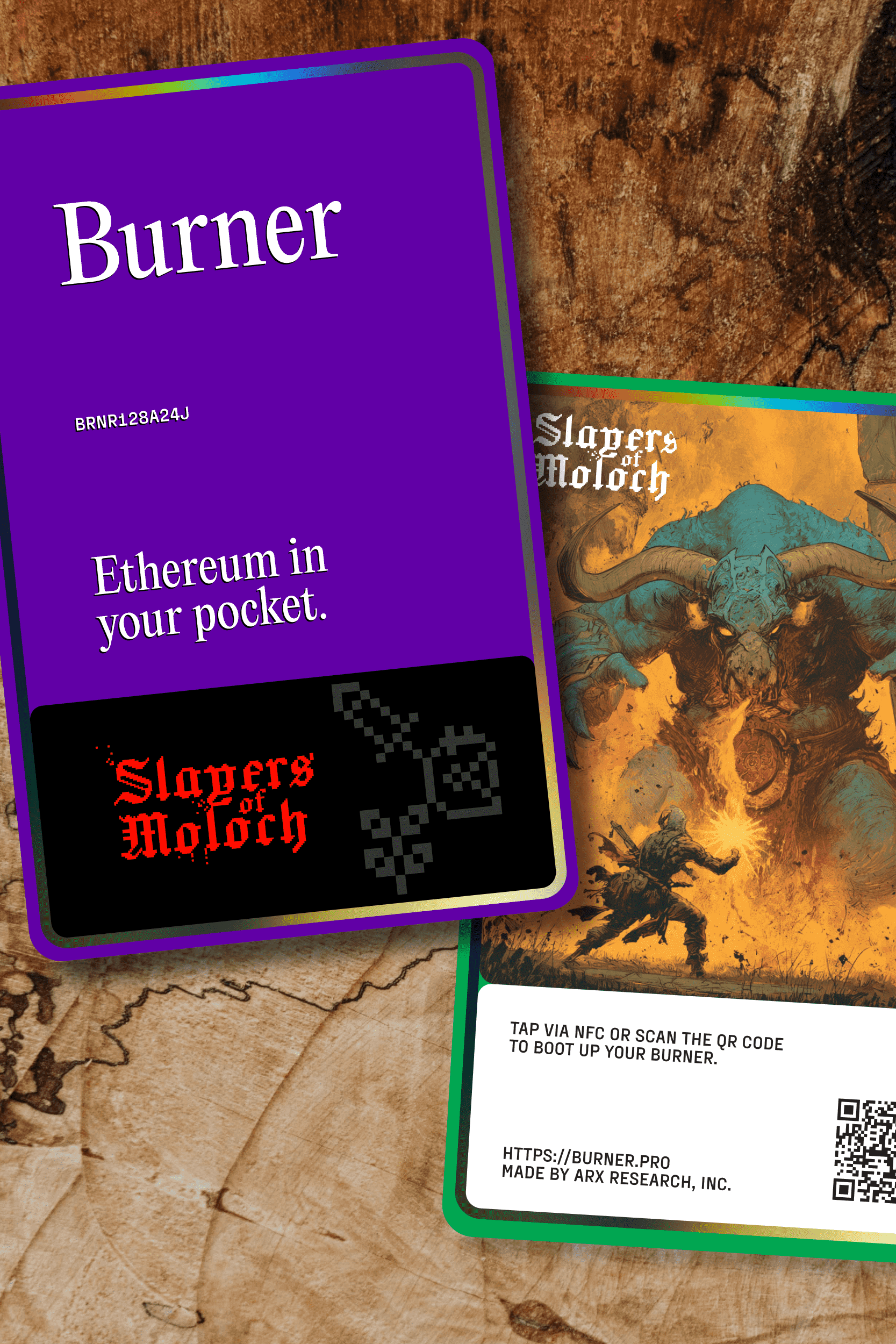
The project was called Slayers of Moloch — a gamified experiment built on top of Burner Cards (burner.pro), deployed at Devconnect (devconnect.org), and powered by Ethereum and GTC.
On the surface, it looked like a game. Underneath, a working prototype for a new kind of economic and creative infrastructure began to power up.
Burner Cards, Explained (Scientifically)
At the core of this project was NFC technology.
NFC (Near Field Communication) is a short-range wireless protocol that allows two devices to exchange data when they’re within a few centimeters of each other. It’s the same technology used in contactless payments, transit cards, hotel keys, and passports.
An NFC card is not “smart” in the way a laptop is. But it does contain a microcontroller and memory capable of storing executable instructions and cryptographic identifiers. In simpler terms:
A small, specialized computer can live inside a clear plastic card.
This is fundamentally different from an NFT.
- NFT → a tokenized reference stored on a blockchain
- NFC → a physical interface that triggers computation in the real world
In Slayers of Moloch, NFC acted as the bridge between physical play and digital agency — turning a card tap into an on-chain interaction.
Why a Proof of Concept (POC) Matters
From proposal to delivery, Lucian and I worked as a tight IRL/URL loop to rapidly unpack a POC — Proof of Concept.
A POC is not about polish. It’s about carving out truth.
A POC answers three critical questions quickly:
- Is this technically viable?
- Is this legible to humans?
- Does it create momentum instead of friction?
In this case, the POC proved something important: Gamification, game theory, and play theory reinforce agency when designed together
1. Play lowers the cognitive barrier.
2. Game mechanics introduce choice, consequence, and progression.
3. *Agency emerges when participants feel their decisions matter.
Building with Local* Agency, we see this funnel in action.
Local* Agency, Operating *Agentically
My role, providing Local* Agency is to operate *Agentically — responding to evolving constraints while maintaining a coherent creative and strategic spine.
Working *Agentically, the work unfolded through these osmotic layers:
- Creative & Art Direction
This formed the scaffolding of the original proposal with Kevin Owocki, founder of Gitcoin and Allo.Capital. - Creative & Product Strategy
I applied my Early Stage Processes to define how a toolkit could be generated quickly — something Lucian and the engineering team could critique, systemize, and translate directly into code. - Brand Design, Visual Development, and Product Design
Operating as a Generalist; I applied my skillsets across Senior Brand Design, UI/X Design, and the Visual Development to yield the direction, tone, and toolkits needed to work with and further guide Lucian's brilliant Engineering and Product Ownership. It
This is where *Agency becomes *Agentic: creative intent → modular systems → autonomous execution → distributed irl/url team* building (the team* really matters with this form of building).
Assembly as Ritual > Logistics
At RegenHub.xyz, we tend to treat self-assembly as part of the experience — not an afterthought.
The Slayer of Moloch Burner Cards were no different.
On a lovely Friday afternoon, somewhere between happy hour and collective focus, we gathered to assemble the cards by hand. Glue dots (the same kind used in credit card mailers) fixed NFC chips onto designed instructional postcards. Stickers were applied. Archetypes were chosen.
Each card belonged to a class:
- Bard
- Monk
- Wizard
- Paladin
…and others — because this was a game, after all.
What I learned in this assembly: The process mattered. Participation mattered. The ritual of assembly reinforced the system of experience. What was reenforced, at this time of Ritual was:
*Agency doesn’t emerge, only, at the interface level—it emerges in the ritual of making, communally.
Toward New Active Economies
This project tied directly into something I’ve been exploring deeply at Local* Agency: New Active Economies. New Active Economies treat finance not as an abstraction, but rather as a narrative layer — something real people can enter, understand, and shape to impact higher levels of shared value. The more we* pay attention to shared financial infrastructure, the more capable we* become of designing shared value systems that are legible, playful, and human.
One central intention. Many semi-autonomous arms. Each executing, sensing, and responding in parallel. An *Agentic Octopus is born! Article coming soon.
Slayers of Moloch was small by design. It pointed toward something much larger. A future where creative development, economic systems, and technical exploration no longer compete — they collaborate. This POC project points towards the kind of work I'm most interested in advancing, in 2026.
Slay!
Inside Slayers of Moloch: A Proof of Concept for Agentic Economies
Slayers of Moloch documents a live experiment built with Gitcoin and Lucian Hymer at Devconnect — exploring how NFC-enabled Burner Cards, game mechanics, and onchain infrastructure can work together to create more agentic economic systems. Through a rapid Proof of Concept, this project demonstrates how play, ritual, and collaborative design pipelines can translate creative intent into modular, executable systems — pointing toward the future of New Active Economies where humans and systems co-create shared value.